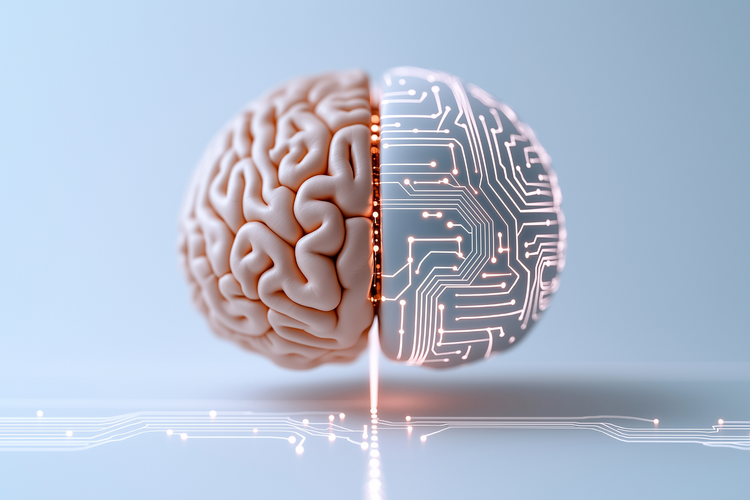
What Is Neuromorphic Computing? The Brain-Inspired Future of AI Hardware
Running modern AI is expensive in money, time, and energy. Neuromorphic computing is a different approach to hardware design, one that takes inspiration from how biological nervous systems process information: efficiently, in parallel, and only when something actually happens. It will not replace your GPU tomorrow, but it could matter enormously for AI at the edge, in robots, in sensors, and anywhere power consumption is a constraint.
Key Takeaways
TL;DR
Key Article Navigation
Table of Contents
- What Is Neuromorphic Computing?
- Why Neuromorphic Computing Matters
- How Neuromorphic Computing Works
- The Core Parts of Neuromorphic Computing
- Neuromorphic Computing vs. Traditional Computing
- Real-World Examples of Neuromorphic Computing
- Why Neuromorphic Computing Became Important
- What Neuromorphic Computing Is Good At
- Where Neuromorphic Computing Falls Short
- What Beginners Should Remember
- FAQ
Training and running advanced AI systems require serious computing power. That is not just a technical footnote. It affects cost, energy use, infrastructure, and where AI can realistically run.
The chips that power today’s most capable AI systems are extraordinary pieces of engineering. But they were designed for a particular kind of work: massive, parallel mathematical operations repeated at enormous scale. For that task, they are excellent. For other tasks, such as constant low-power sensing, real-time reaction to sparse events, intelligence embedded in a drone, or AI inside a medical device, they can be badly overspecified, power-hungry, and impractical.
Neuromorphic computing is one of the more interesting attempts to address this mismatch. The core idea is to design hardware that does not follow the conventional computing model, but instead borrows structural principles from biological nervous systems: neurons, synapses, spike-based communication, and event-driven processing.
It is not a magic solution, and it is not close to replacing the hardware behind large language models or image generators. But for edge AI, robotics, smart sensors, and always-on systems where energy is a hard constraint, neuromorphic computing represents a genuinely different approach. As AI moves off the server and onto the device, that difference matters.
What is neuromorphic computing?
Neuromorphic computing is a hardware approach that designs chips to process information more like biological nervous systems do, using artificial neurons and synapses that communicate through electrical spikes rather than continuous data flows.
The goal is to handle certain tasks, especially sensing, pattern recognition, and real-time decision-making, using far less energy than conventional processors. It is brain-inspired engineering, not a synthetic brain.
Neuromorphic computing is a hardware design approach that models the structure and behavior of biological neurons and synapses to create chips capable of processing information in an event-driven, energy-efficient way, making them especially suited for real-time AI tasks at the edge of the network.
What Is Neuromorphic Computing?
Neuromorphic computing is a hardware design philosophy. The goal is to build chips that process information in a way that is structurally similar to how biological nervous systems do, not to simulate a brain, but to apply a few of its most useful engineering principles to silicon.
In a conventional computer, processing and memory are separate. The processor asks for data, the memory delivers it, the processor does something with it, and the result goes back to memory. This back-and-forth happens constantly, often on a fixed clock cycle, regardless of whether anything interesting is actually happening. It is powerful and flexible, but it carries overhead.
Biological neurons do not work that way. They sit mostly quiet until they receive enough input to cross a firing threshold. When they fire, they send a brief spike of electrical activity to connected neurons. Processing and memory are intertwined because the strength of connections between neurons changes in response to activity, encoding information in the network itself rather than in a separate storage location. The system is sparse, parallel, event-driven, and remarkably efficient relative to what it accomplishes.
Neuromorphic chips try to capture these principles. They use large arrays of artificial neurons and artificial synapses, communicate through spikes rather than continuous numerical signals, and process information locally, at the point where data arrives, rather than routing everything through a central processor.
“Brain-inspired” is accurate as a descriptor. “Brain-equivalent” is not. A neuromorphic chip does not think, reason, or have anything resembling consciousness. It processes information in a particular way that happens to share some structural features with biological nervous systems. The resemblance is an engineering strategy, not a metaphysical claim.
Key idea: neuromorphic computing matters because it tries to process information more like biological nervous systems: event-driven, parallel, adaptive, and energy-efficient.
- Event-driven processing: computations happen only when activity occurs, not continuously on a fixed clock cycle
- Parallel computation: many artificial neurons process information simultaneously instead of working through everything sequentially
- Lower energy consumption: because the system only activates when needed, it can use less power for certain workloads
- Better fit for sensory data: the event-driven model maps naturally onto audio, vision, and environmental sensing tasks common in edge AI and robotics
Why Neuromorphic Computing Matters
The energy cost of AI is not an abstract concern for the distant future. It is a present constraint that shapes what is possible today. Data centers running AI workloads consume significant electricity, and demand is growing as AI becomes more widely used across products, businesses, and everyday software.
When AI runs in a data center, the economics of power consumption are real but manageable. When AI needs to run on a device, such as a drone, hearing aid, industrial sensor, vehicle, or medical monitor, the equation changes completely. These systems often run on batteries. They cannot shed heat like a server rack. They may need to operate continuously, sometimes for months or years, without waking up a cloud connection every time they need to make a decision.
This is where neuromorphic computing starts to look genuinely attractive. A chip that processes only when relevant events occur and consumes minimal power in between is a fundamentally better fit for always-on sensing and edge intelligence than a scaled-down version of hardware designed for a data center.
The application space is not narrow. Robotics needs efficient real-time perception. Autonomous systems benefit from vision and sensor processing that react to changes rather than constantly processing every possible input. Smart building sensors, medical monitoring devices, and industrial inspection systems all share the same need: continuous, efficient, locally processed intelligence that does not drain power or require a constant network connection.
Neuromorphic computing will not replace the hardware behind large language models. But it may reshape the hardware layer that handles sensing, perception, and real-time decision-making. That layer is becoming more important as AI moves into the physical world.
How Neuromorphic Computing Works
The starting point is the artificial neuron. Like its biological counterpart, an artificial neuron in a neuromorphic system accumulates incoming signals. When the total reaches a threshold, the neuron fires, producing a spike: a brief output signal that travels to other neurons through artificial synapses. Below the threshold, the neuron remains quiet and consumes very little energy.
Artificial synapses are the connections between neurons. Each synapse has a weight, which is a value that determines how strongly one neuron’s output influences another neuron’s input. In many neuromorphic designs, these weights can change over time in response to activity. This allows the system to adapt and, in some implementations, learn.
The language of spikes is central to understanding how neuromorphic systems differ. In conventional neural networks, the software kind used in deep learning, information is represented as continuous numerical values passed between layers. In spiking neural networks, information is encoded in the timing and pattern of discrete spike events. A neuron that fires frequently says something different from one that fires rarely, and the relationship between two neurons’ firing patterns can encode complex information.
The event-driven model follows naturally from this. Because spikes are discrete events rather than continuous signals, computation only needs to happen when spikes arrive. Between events, the system is largely idle. This is fundamentally different from a GPU or CPU, which runs on a fixed clock cycle and consumes power whether or not anything useful is happening. The sparse, event-driven nature of neuromorphic processing is the main reason it can be more efficient for certain workloads.
The other architectural difference worth noting is memory proximity. One of the significant inefficiencies in conventional computing is the constant data movement between processor and memory. Neuromorphic systems reduce this by distributing computation across the network of neurons and synapses. The “memory” of the system, encoded in synaptic weights, is local to the processing elements that use it. Less data movement means less energy consumed.
The core parts of neuromorphic computing
Neuromorphic systems combine hardware and computation in a way that looks very different from conventional processors.
Artificial neurons receive inputs, accumulate signals, and fire an output spike when a threshold is crossed. They are the fundamental computational units of a neuromorphic system.
Artificial synapses connect neurons and carry weighted signals between them. Their strength can change over time in response to activity, allowing the system to adapt.
Neuromorphic systems communicate through discrete spikes, or brief electrical pulses, that signal when something has happened. Information is encoded in timing and patterns.
Neuromorphic chips are purpose-built processors that implement artificial neurons, synapses, and spike-based communication in silicon.
The Camera That Only Sees Change
A conventional camera captures a full image at a fixed frame rate, whether or not anything in the scene is moving. An event-based vision sensor works differently. Each pixel operates independently and sends a signal only when the light hitting it changes.
If nothing moves, nothing fires. If a bird flies through the frame, only the pixels it passes activate. The result is a sparse stream of timestamped events rather than a dense stream of frames. That maps naturally onto neuromorphic processing: less data, lower power use, and faster reaction to change.
Neuromorphic Computing vs. Traditional Computing
Comparing neuromorphic chips to conventional hardware requires being clear about what is being compared, because the question “which is better?” does not have a single answer. They are suited to different things.
Traditional CPUs are general-purpose processors. They are designed to execute diverse instructions in a flexible order, which makes them good at a wide range of computing tasks but not optimized for every workload. For many AI workloads, CPUs are usually too slow or too sequential on their own.
GPUs and purpose-built AI accelerators filled that gap. They are massively parallel, capable of running many operations simultaneously, which maps well onto the mathematical operations at the core of deep learning. They are one reason large AI models became practical to train and run. The tradeoff is power. High-end AI hardware can consume a lot of energy, which makes sense in a data center but less sense inside a small embedded device.
Neuromorphic chips occupy a different position on the tradeoff curve. They are not well-suited to training large deep learning models because that workload does not fit the architecture. They are not intended to replace GPUs in that role. What they offer is a different efficiency profile for a different category of tasks: sparse, event-driven, low-latency, sensor-adjacent workloads where power consumption is the binding constraint and where the data naturally arrives as events rather than dense numerical arrays.
The honest framing is that neuromorphic computing is not a better version of today’s AI hardware. It is a different approach with a different set of tradeoffs, suited to a meaningful but distinct set of applications.
| Concept | Simple Explanation | Best For | Limitation |
|---|---|---|---|
| Traditional CPUs | General-purpose processors that execute instructions across a wide range of tasks. | Everyday computing, operating systems, applications, and flexible workloads. | Not designed for AI-scale parallel computation and can face high memory transfer overhead. |
| GPUs / AI Accelerators | Highly parallel processors designed to handle many simultaneous calculations. | Training and running deep learning models at scale. | Can require significant power and are not optimized for sparse, event-driven workloads. |
| Neuromorphic Chips | Brain-inspired processors using spiking neurons and event-driven computation. | Low-power sensing, real-time edge AI, robotics, and always-on monitoring. | Harder to program, less mature ecosystem, and not suited for large-scale deep learning training. |
Real-World Examples of Neuromorphic Computing
Neuromorphic computing is not purely theoretical. Research institutions, chipmakers, and hardware labs have been exploring neuromorphic systems for years, and a growing set of applications are testing the approach in real environments.
Robotics is one of the most natural fits. A robot navigating a physical environment needs to process sensory input continuously, react in real time, and do so within an onboard power budget. Neuromorphic processors can support more efficient sensory processing and motor control for these kinds of systems.
Event-based vision sensors are another concrete example. Unlike conventional cameras that capture a full frame at a fixed rate, event-based cameras only register changes in the visual field. A pixel sends a signal only when its light intensity changes. This produces a sparse stream of events rather than a dense stream of frames, which maps naturally onto neuromorphic processing.
Beyond these anchor examples, neuromorphic approaches are being explored across low-power audio detection, smart industrial sensors, medical devices, autonomous vehicle perception, drones, and always-on monitoring systems. The common thread is real-time sensing, tight energy constraints, and workloads that are naturally event-driven.
Why Neuromorphic Computing Became Important
Neuromorphic computing has been discussed in research circles for decades. What changed is the context around it.
The energy demands of AI have become harder to ignore. Training large AI models requires enormous compute infrastructure, and inference, the act of running models to produce outputs, is becoming a major ongoing cost as AI applications spread. The question of what happens when AI moves beyond the data center has sharpened this problem considerably. Edge AI cannot assume access to unlimited power or constant cloud connectivity.
At the same time, the number of applications demanding edge AI has expanded. Autonomous vehicles need to process sensor data in real time without relying on a network connection. Drones and robots need embedded intelligence that fits within strict size and power budgets. Wearables and medical devices need to monitor biological signals continuously without draining batteries in hours. The list is long, and it keeps growing.
The limits of conventional architectures became clearer in this context. Scaling down a GPU to fit an edge device does not automatically produce hardware suited for edge intelligence. It can produce a compromised, still-power-hungry chip that struggles to meet the constraints. A different architectural approach starts to look useful.
Better chip design tools, more mature research into spiking neural networks, and increased investment in next-generation AI hardware have all helped bring neuromorphic computing from academic curiosity toward early practical deployment. It remains early, but the drivers pushing it forward are not going away.
What Neuromorphic Computing Is Good At
Neuromorphic computing’s strengths align directly with its architecture. The event-driven, spike-based, memory-local processing model is well-suited to tasks that share a few common characteristics: the data arrives as sparse events rather than dense arrays, the system needs to respond quickly with minimal latency, energy efficiency is a hard constraint rather than a preference, and the workload does not require the kind of large-scale operations that GPUs handle well.
Low-power sensing sits at the center of this. An always-on environmental monitor that reacts to sound, motion, temperature change, or chemical presence, and does so on a small battery for long periods, is exactly the kind of workload neuromorphic hardware is designed for. The system stays quiet until something worth reacting to occurs, then fires and returns to idle.
Pattern recognition from sensor data is closely related. Detecting an anomalous vibration in industrial equipment, identifying a particular audio signature, or recognizing a gesture from an inertial sensor are all tasks where the input is temporal, sparse, and event-like. Neuromorphic systems are designed to handle these kinds of inputs more naturally.
Robotics and autonomous perception also benefit from the real-time, low-latency characteristics. A robot that needs to avoid an obstacle does not have time for a round-trip to a remote processor. Local, fast, efficient sensing and reaction is the requirement, and neuromorphic architectures address that directly.
Neuromorphic computing is especially useful for:
- Low-power sensing and environmental monitoring
- Event-based vision and audio detection
- Real-time pattern recognition from sensor data
- Edge AI workloads on battery-constrained devices
- Robotics and autonomous system perception
- Always-on monitoring with minimal standby power
- Adaptive systems that adjust to changing conditions
- Time-sensitive decisions driven by sparse, event-driven inputs
Where Neuromorphic Computing Falls Short
The same architectural properties that make neuromorphic computing efficient for certain workloads create genuine challenges for others.
Programming neuromorphic systems is hard. The spiking neural network paradigm does not map neatly onto the frameworks most AI developers use. Translating a conventional trained neural network into a spiking equivalent is difficult and often involves performance tradeoffs. The developer ecosystem is immature compared to conventional AI hardware, which means longer development cycles, less tooling support, and a smaller community to draw on.
Neuromorphic chips are not well-suited to training large deep learning models. The workload simply does not fit. If the goal is training a large language model or a state-of-the-art image classifier, neuromorphic hardware is not the answer.
Benchmarking is also a persistent challenge. The metrics used to evaluate conventional AI hardware do not translate directly to neuromorphic systems. Comparing performance across architectures can be difficult, which complicates both research evaluation and procurement decisions.
Mainstream adoption is limited. Despite years of research and early commercial work, neuromorphic hardware has not achieved broad deployment. Most AI workloads today run on conventional hardware, and that is unlikely to change quickly. The tooling, talent pipeline, and application playbooks are all more developed for conventional approaches.
None of these limitations are permanent. But they are real, and they matter for anyone evaluating whether neuromorphic computing is relevant to their work today.
Neuromorphic computing is not a synthetic brain, and it does not produce artificial consciousness or general intelligence. "Brain-inspired" means the hardware borrows certain structural principles from biology, not that it replicates biological cognition. Neuromorphic chips are also not an automatic replacement for GPUs or the hardware behind today's large AI models. They are better suited to specific tasks, especially low-power, event-driven, real-time sensing workloads. The field is genuinely promising, but still early.
Glossary
Key Terms
- Neuromorphic Computing
- A hardware design approach that models the structure and behavior of biological neurons and synapses to create chips that process information in an event-driven, energy-efficient way.
- Artificial Neuron
- A processing unit in a neuromorphic chip that accumulates incoming signals and fires a spike when its activation threshold is crossed.
- Artificial Synapse
- A connection between artificial neurons that carries a weighted signal. Synaptic weights can be adjusted over time, enabling the system to adapt.
- Spiking Neural Network
- A type of neural network that communicates through discrete spike events rather than continuous numerical values.
- Event-Driven Processing
- A computing model in which operations occur only when an event is received, rather than running continuously on a fixed clock cycle.
- Edge AI
- AI that runs locally on a device, sensor, robot, wearable, or embedded system instead of in a remote data center.
- Sensor Data
- Data produced by physical sensors, such as cameras, microphones, accelerometers, temperature probes, and environmental monitors.
- AI Accelerator
- A processor designed specifically for AI workloads, especially the mathematical operations used in deep learning.
The Neuromorphic Fit Test
When neuromorphic computing may be worth considering:
Use this as a quick fit check. Neuromorphic computing is most relevant when the system needs low-power, real-time, event-driven processing at the edge.
- The system processes real-time sensory data, such as vision, audio, motion, or environmental signals
- Energy consumption is a hard constraint because the system is battery-powered, thermally limited, or cost-constrained
- The system needs to run on-device without relying on cloud connectivity for processing
- Always-on monitoring is required, but constant full-power processing is not practical
- Latency matters and the system needs to react within milliseconds, not seconds
- The workload is naturally event-driven, with inputs arriving as discrete events rather than continuous data streams
- Conventional hardware is already proving too power-hungry or too large for the application
- The system operates at the edge, not in a data center
Mistakes
Thinking neuromorphic computing creates consciousness
Neuromorphic chips borrow structural principles from biology. They do not replicate biological cognition, awareness, or anything resembling consciousness. Better way to think about it: neuromorphic computing is an engineering approach to efficiency, not synthetic sentience.
Thinking it replaces GPUs
Neuromorphic chips are not substitutes for GPUs for most current AI workloads. Better way to think about it: they address edge sensing and real-time response, not large-model training.
Thinking "brain-inspired" means biologically identical
The resemblance between neuromorphic hardware and biological nervous systems is architectural and metaphorical. Better way to think about it: neuromorphic design borrows useful engineering principles from biology without copying biology literally.
Thinking it is already mainstream
Neuromorphic computing remains an emerging field. Better way to think about it: it is worth watching and understanding, not something most teams need to retool around today.
Thinking it only matters for robots
Robotics is a natural fit, but the application space is broader. Better way to think about it: anywhere real-time sensing meets tight energy constraints is a potential neuromorphic use case.
What Neuromorphic Computing Gets Right
- Lower power consumption for certain event-driven workloads
- Faster reaction to incoming events through event-driven processing
- Strong fit for always-on sensing without continuous full-power operation
- Reduced data movement because memory and processing are closer together
- Natural fit for sparse, temporal, sensory data streams
- Useful for embedded and edge applications with size and thermal constraints
Where It Falls Short
- Programming neuromorphic hardware is harder than conventional AI development
- Developer ecosystem and tooling are less mature
- Not suited to training large deep learning models
- Limited mainstream deployment compared with conventional hardware
- Benchmarking and performance comparison can be difficult
- Translating conventional models to spiking equivalents involves tradeoffs

Do
- Understand neuromorphic computing as a hardware approach suited to specific tasks
- Consider it for edge AI, robotics, and sensing applications with tight power budgets
- Follow the research because the field is still developing
- Treat it as one layer in a broader hardware ecosystem
- Evaluate it against the specific constraints of your use case
Don't
- Claim that neuromorphic computing creates consciousness or a synthetic brain
- Assume neuromorphic chips will replace GPUs for mainstream AI workloads soon
- Confuse "brain-inspired" with "biologically equivalent"
- Dismiss the field just because it is not mainstream yet
- Overstate deployment readiness before evaluating maturity honestly
Neuromorphic computing is not trying to copy the brain. It is trying to steal a few useful engineering lessons from biology and apply them where conventional hardware runs out of patience.
What Beginners Should Remember
Neuromorphic computing is not a technology that will replace everything you know about AI hardware next year. It is a design philosophy, one that says certain problems can be handled more efficiently if you build hardware that processes information more like a nervous system does, rather than like a conventional computer does.
The core ideas are accessible. Artificial neurons fire when thresholds are crossed. Artificial synapses carry weighted connections. Spikes carry information through timing and pattern. The system activates when events happen, not on a fixed clock. Processing happens close to the data. These principles add up to hardware that can be dramatically more efficient for the right workloads and much less suited for the wrong ones.
The right workloads, for now, are edge AI, real-time sensing, robotics, and always-on monitoring systems where energy is the binding constraint. The wrong workloads are large model training and tasks that benefit from the massive parallel compute that GPUs deliver.
What neuromorphic computing is not: a brain in a chip, a path to artificial consciousness, or a magic solution to the energy costs of modern AI. It is an engineering approach with real promise, real limitations, and a development trajectory worth watching as AI moves deeper into the physical world.
Build Your AI Hardware Vocabulary
Neuromorphic computing is one piece of a larger hardware story. The BuildAIQ AI Concepts Starter Guide covers the key terms, technologies, and ideas you need to understand how modern AI is built and where it is going.
Get the Free Guide →Free Resource
Build Your AI Hardware Vocabulary
Neuromorphic computing is one piece of a larger hardware story. The BuildAIQ AI Concepts Starter Guide covers the key terms, technologies, and ideas you need to understand how modern AI is built and where it is going.
Get the Free Guide →FAQs
Frequently Asked Questions
What is neuromorphic computing in simple terms?
Neuromorphic computing is a way of designing chips that process information using structures similar to biological neurons and synapses. Instead of moving data back and forth between memory and processor on a fixed clock, the system communicates through electrical spikes and processes information only when something relevant happens.
Why is it called neuromorphic computing?
The term combines "neuro," referring to neurons and the nervous system, with "morphic," referring to form or structure. It describes hardware inspired by nervous system architecture, not hardware that functions with the full complexity of a brain.
Is neuromorphic computing the same as AI?
No. Neuromorphic computing is a hardware approach. AI is a broad field with many techniques that can run on many types of hardware. Neuromorphic chips can support certain AI workloads, but most AI today runs on conventional CPUs, GPUs, and AI accelerators.
How does neuromorphic computing work?
Neuromorphic chips contain artificial neurons and artificial synapses. Neurons accumulate incoming signals and fire a spike when a threshold is crossed. Those spikes travel through synaptic connections to other neurons, allowing the system to process information through patterns of activity.
How is neuromorphic computing different from traditional computing?
Traditional computers typically separate memory and processing, which requires constant data transfer between them. Neuromorphic systems process information more locally and respond to events rather than running continuously on a clock, making them more efficient for certain sensing and pattern-recognition tasks.
Is neuromorphic computing the same as a human brain?
No. Neuromorphic chips borrow structural principles from biology, such as neurons, synapses, and spike-based communication, but they are far simpler than biological nervous systems and do not produce cognition or consciousness.
What is neuromorphic computing used for?
Potential applications include robotics, edge AI devices, autonomous perception, smart sensors, drones, always-on monitoring systems, low-power medical devices, and event-based vision systems.
Why does neuromorphic computing matter for AI?
As AI moves beyond data centers and onto devices, energy efficiency becomes a hard constraint. Neuromorphic approaches could help handle sensing and real-time processing more efficiently, especially in edge AI environments.
What are the limitations of neuromorphic computing?
Neuromorphic chips are harder to program, the developer ecosystem is less mature, mainstream adoption is limited, and they are not well-suited to training large deep learning models. Benchmarking across architectures can also be difficult.
What is the main takeaway?
Neuromorphic computing is a hardware approach that borrows principles from biological nervous systems to process information more efficiently, especially for sensing, real-time pattern recognition, and edge AI. It is not a synthetic brain, but it is an important direction to watch.