

How Does AI Work? A Simple Breakdown of What’s Underneath the Hood
AI can write, recognize faces, and generate images. Understanding what drives those capabilities — data, machine learning, neural networks — helps you use AI more effectively and question it more intelligently.
Key Takeaways
TL;DR
Key Article Navigation
Table of Contents
- What Does It Mean for AI to "Work"?
- The Three Core Parts of AI
- Machine Learning: How AI Learns From Examples
- The Three Ways AI Learns
- Training vs. Inference
- How Neural Networks Work
- What Deep Learning Means
- How Generative AI Creates New Outputs
- Why AI Can Still Get Things Wrong
- Common Mistakes About How AI Works
- What Beginners Should Remember
- FAQ
When you ask an AI assistant a question, get a streaming recommendation, or watch your inbox quietly filter out phishing emails, you are seeing the same basic process playing out in different forms. Behind the scenes, AI is doing what it was built to do: learning patterns from data and using those patterns to respond.
Artificial intelligence has become one of the most widely used technologies in everyday life — and one of the most misunderstood. It can answer questions, write paragraphs, recognize faces, detect fraud, generate images, translate languages, and help with complex decisions. But underneath all of that capability, there is no magic.
This article explains what is actually happening inside AI systems: how they learn, what they learn from, how they apply that learning, and why they can still get things wrong. If you want to start with a broader definition first, What Is AI? is the place to begin.
How does AI work?
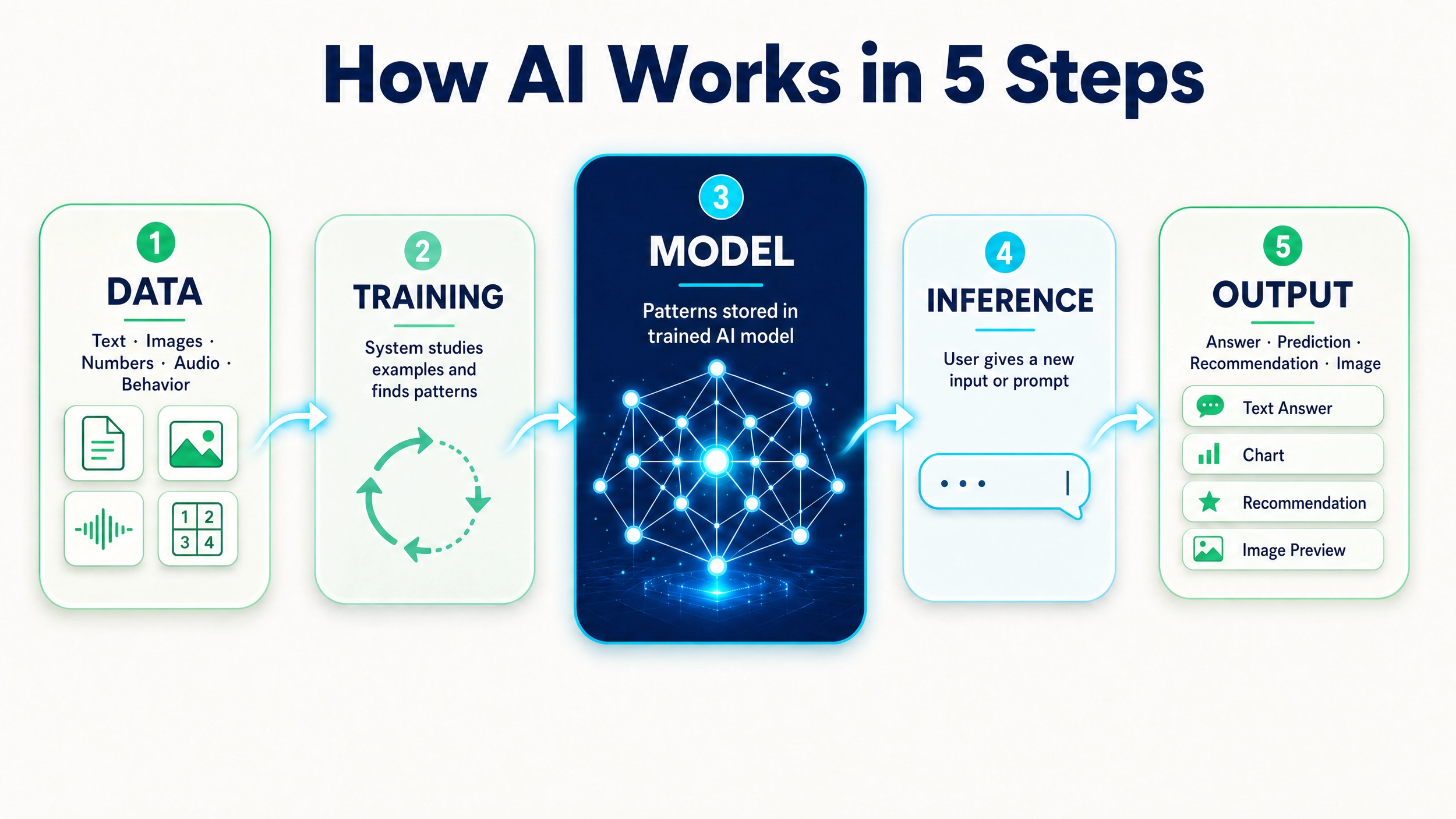
AI works by learning patterns from data, then using those patterns to make predictions, generate outputs, or complete tasks. The core ingredients are data (what it learns from), algorithms (how it learns), and computing power (what makes training possible at scale).
When you interact with any AI system — a chatbot, a recommendation engine, a fraud detector — you are seeing the result of that pattern-learning process in action. The model was trained on examples, and it is now applying what it learned to a new input: yours.
What Does It Mean for AI to "Work"?
When most people ask how AI works, they are really asking: how can a machine do something that feels intelligent?
How does it recognize a face it has never seen? How does it answer a question it was not programmed to answer? How does it recommend the right movie? How does it generate text that sounds like a human wrote it?
The answer varies by system, but most modern AI follows a similar sequence. It receives data — text, images, numbers, audio, behavior records, or some other form of input. It finds patterns in that data. It builds a model based on those patterns. It uses that model to produce predictions or outputs when given something new.
A spam filter, for example, is trained on thousands of emails — some labeled spam, some labeled not spam. Over time, it learns patterns associated with unwanted messages: suspicious links, certain phrases, unusual sender behavior, and formatting tricks. Once trained, it can evaluate a new incoming email and predict whether it belongs in your inbox or your spam folder.
That is AI working as designed: recognizing patterns learned from examples and applying them to new situations.
The Three Core Parts of AI
Most AI systems depend on three things working together: data, algorithms, and computing power.
Data gives the system something to learn from. Without enough high-quality data, an AI system has nothing to work with. The kind of data varies widely — it might be text, images, audio, transaction records, customer behavior, medical scans, or anything else a system can analyze for patterns.
Algorithms provide the method for learning. An algorithm is a set of instructions that guides how the system should find patterns, update its understanding, and improve over time. It is the approach the system uses, not the final model itself.
Computing power makes the process possible at scale. Training a large AI model can involve processing billions of data points and performing trillions of mathematical calculations. That requires specialized hardware — especially GPUs, which are well-suited for the parallel processing that AI training demands — as well as cloud infrastructure and significant energy.
Modern AI advanced quickly because all three areas improved at the same time. More data became available. Algorithms became more sophisticated. And computing hardware became powerful enough to train much larger, more capable models. The combination is what made the recent surge in AI capability possible.
The three core ingredients
Every AI system depends on these three elements working together. Weaken any one of them and the system becomes limited.
The examples AI learns from. This might be text, images, audio, numbers, behavioral records, or any other information the system can analyze for patterns.
The method that guides how the system finds patterns and improves. An algorithm tells the model how to learn — it is not the model itself, but the approach used to build it.
The hardware and infrastructure that makes large-scale training possible. Modern AI relies heavily on GPUs, cloud computing, and significant processing capacity.
Machine Learning: How AI Learns From Examples
Machine learning is the core method behind most modern AI — and understanding it is the key to understanding everything else.
Traditional software follows rules written by hand. A developer writes: if this email contains this phrase, mark it as spam. If the password is wrong, return an error. If the user clicks this button, show this menu. The rules are explicit and fixed.
Machine learning works differently.
Instead of programming every rule manually, developers give the system data and a learning method. The system analyzes examples, finds patterns, and develops its own ability to handle new inputs. The rules emerge from the data rather than from the developer's instructions.
This shift matters because many real-world tasks are too complex to define rule by rule. Writing every rule needed to recognize a cat in a photograph, translate a sentence between languages, or generate a coherent paragraph would be impossibly difficult. Machine learning lets AI handle these tasks by learning from examples instead.
Machine learning: A method that allows AI systems to learn from examples rather than following fixed rules written by hand. The system analyzes data, identifies patterns, and builds a model it can use to respond to new inputs — getting better as it sees more examples.
A model trained to recognize cats, for example, is shown many images — some labeled as cats, some labeled as not cats. At first, it may perform poorly. Over time, it starts identifying visual patterns common in cat images: shapes, features, proportions, textures. Eventually, it can look at a new image it has never seen and predict whether a cat is in it.
That same basic idea applies across nearly every AI system you interact with. A fraud detection model learns from past transactions. A recommendation model learns from behavior patterns. A language model learns from text. The system is learning statistical patterns that help it respond to inputs it has never seen before.
The Three Ways AI Learns
AI systems can learn in different ways depending on the task, the data, and the goal. The three most common learning approaches are supervised learning, unsupervised learning, and reinforcement learning.
Supervised learning is the easiest to understand. The system learns from examples that already have correct answers attached. If you train a model to identify dog photos, you show it many images labeled “dog” and many images labeled “not dog.” The system compares its guesses to the correct labels and adjusts until it gets better.
Unsupervised learning is different. The system looks for patterns in data without being told the right answer. It might group similar customers, detect unusual behavior, organize documents by theme, or find hidden patterns in large datasets. There is no answer key. The model is looking for structure.
Reinforcement learning works through trial and error. The system takes actions, receives feedback, and learns which actions lead to better results. This approach is often used in robotics, games, simulations, and systems that need to optimize behavior over time.
These methods are not mutually exclusive. Many modern AI systems combine techniques, especially as models become more complex. But the basic idea stays the same: AI improves by finding patterns, receiving feedback, and adjusting how it responds.
| Learning Type | How It Works | Simple Example | Best For |
|---|---|---|---|
| Supervised Learning | The model learns from labeled examples with known correct answers. | Training an email filter with messages labeled spam or not spam. | Classification, prediction, detection, and tasks with clear answer keys. |
| Unsupervised Learning | The model looks for patterns or groups in data without labeled answers. | Grouping customers based on similar shopping behavior. | Clustering, pattern discovery, segmentation, and anomaly detection. |
| Reinforcement Learning | The model learns by taking actions and receiving rewards or penalties. | Teaching a game-playing AI which moves lead to better outcomes. | Robotics, games, simulations, optimization, and decision-making systems. |
Training vs. Inference
Two terms matter a lot when you are trying to understand how AI works: training and inference.
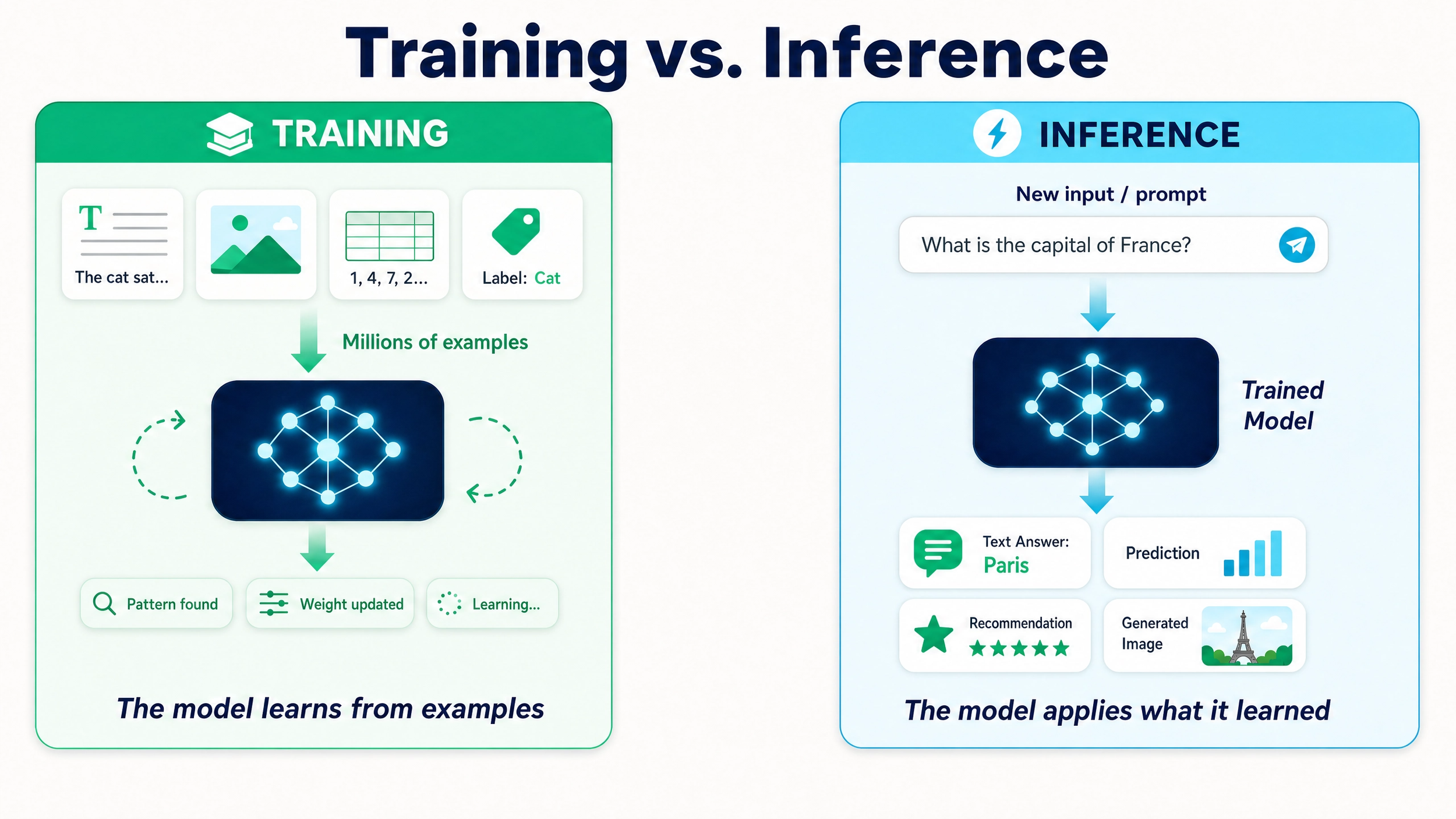
Training is the learning phase. This is when the model analyzes data, identifies patterns, adjusts its internal settings, and improves its performance. Training can take a long time and require enormous computing resources, especially for large models. It is where the system builds the ability it will later use.
Inference is the using phase. This is what happens when you give a trained model a new input and ask it to produce an output. When you type a question into an AI assistant, the model is not usually relearning from scratch in that moment. It is applying what it already learned during training to your specific prompt.
That distinction matters because it explains why an AI tool can respond quickly even though training the model took massive resources. The heavy learning happened earlier. Your interaction is the model applying its learned patterns.
A simple way to think about it: training is studying for the exam. Inference is answering the question.
How Neural Networks Work
Neural networks are one of the most important technologies behind modern AI.
The name sounds biological, but a neural network is not a digital brain. It is a mathematical system inspired loosely by the way neurons connect and pass signals. It contains layers of artificial nodes that process information and pass it forward.
A simple neural network has an input layer, one or more hidden layers, and an output layer. The input layer receives the data. Hidden layers process patterns. The output layer produces a prediction or result.
During training, the model makes guesses and compares them to the correct answers. When it gets something wrong, the system adjusts the strength of connections between nodes. Over many rounds of training, those adjustments help the network make better predictions.
The important point is not that the system “understands” the way a person does. It is that the system has learned useful mathematical relationships between inputs and outputs. Those relationships can be powerful enough to recognize images, translate language, detect fraud, summarize documents, and generate text.
Neural networks are especially useful because they can learn complicated patterns that would be almost impossible to program manually. That is why they became central to deep learning and modern AI.
How a Neural Network Learns to Recognize a Dog
Imagine showing a model thousands of labeled images: some with dogs, some without. At first, the model guesses poorly. It may confuse dogs with wolves, cats, toys, or furry furniture having an identity crisis.
During training, the system compares its guesses to the correct labels and adjusts its internal connections. Over time, it starts detecting patterns that often appear in dog images: shapes, fur textures, ears, snouts, posture, and surrounding context.
Once trained, the model can look at a new image and predict whether a dog is present, even if it has never seen that exact image before.
What Deep Learning Means
Deep learning is a type of machine learning that uses neural networks with many layers. That word “deep” refers to the number of layers in the network, not the model having profound thoughts in a velvet chair.
Earlier machine learning systems often required humans to define the features the model should pay attention to. For example, if you wanted a system to identify handwritten numbers, a human might design features related to curves, edges, angles, and spacing.
Deep learning changed that. Instead of relying heavily on human-designed features, deep learning systems can learn useful features directly from raw data. In image recognition, early layers might detect edges and colors. Later layers might detect shapes, textures, objects, and more complex patterns.
This ability to learn layered representations is why deep learning became so powerful for tasks like speech recognition, image classification, translation, recommendation systems, and natural language processing.
Deep learning is also one of the reasons modern AI advanced so quickly and dramatically. Once researchers had enough data, enough computing power, and better neural network architectures, AI systems became capable of handling tasks that used to feel out of reach.
How Generative AI Creates New Outputs
Generative AI is the kind of AI that can create new content: text, images, audio, video, code, summaries, outlines, designs, and more.
It works by learning patterns from training data, then using those patterns to generate something new in response to a prompt. A language model, for example, learns statistical relationships between words, phrases, ideas, formats, and styles. When you ask it a question, it predicts what should come next based on your input and everything it learned during training.
That is why generative AI can write a paragraph, summarize a document, draft an email, suggest code, or explain a concept. It is not pulling a prewritten answer from a filing cabinet. It is generating an output based on learned patterns.
This is also why prompting matters. Your prompt gives the model context, direction, constraints, and a goal. A vague prompt produces a vague result. A clear prompt gives the model a better target.
Generative AI can feel more flexible than traditional software because it does not require you to click through fixed menus or use exact commands. You can describe what you want in natural language, and the model attempts to produce it.
But flexibility is not the same as reliability. Generative AI can produce fluent nonsense, miss important context, or invent details. Its outputs need judgment, especially when accuracy matters.
Generative AI does not “know” things the way humans know them. It generates outputs based on learned patterns. That is why it can be useful, fast, and impressively fluent — and still wrong. Treat AI outputs as drafts, predictions, or suggestions that need human review, especially for factual, legal, medical, financial, or high-stakes work.
Why AI Can Still Get Things Wrong
AI can be powerful and still unreliable. That is not a contradiction. It is part of how the technology works.
Because AI learns from data, its performance depends heavily on the data it was trained on. If the data is incomplete, biased, outdated, low-quality, or poorly matched to the task, the model’s outputs can reflect those weaknesses.
Because AI models identify patterns, they can also mistake correlation for meaning. A system may find relationships in data that look useful mathematically but do not hold up in the real world. That is one reason AI can perform well in testing but fail when conditions change.
Generative AI adds another layer of risk. Language models are designed to produce plausible sequences of words, not to guarantee truth. They can explain things confidently even when the explanation is wrong. These mistakes are often called AI hallucinations.
This does not mean AI is useless. It means AI should be used with judgment.
A high-quality AI workflow includes review. You check facts. You verify sources. You compare outputs. You ask what might be missing. You consider whether the task is low-risk or high-risk. You decide where human judgment needs to stay in control.
The better you understand how AI works, the less likely you are to treat it like magic. And that is the point. AI is most useful when you understand both its power and its limits.
AI does not reason the way humans do. It identifies statistical patterns in data and produces outputs based on what fits those patterns best. An AI model that answers a question confidently is not thinking through the answer — it is generating a response that matches patterns in its training data. This is why an AI can sound right and still be wrong, and why human judgment remains essential.
Common Mistakes About How AI Works
Once people understand that AI learns from patterns, the next risk is overcorrecting in the wrong direction. Some people treat AI like a thinking machine. Others dismiss it as autocomplete with better lighting. Neither view is useful.
The better approach is to understand what AI is actually doing, where that makes it powerful, and where that makes it fragile. These are the most common mistakes beginners make when thinking about how AI works.
Thinking AI understands like a person
AI can produce fluent answers without human understanding. Better way to think about it: AI detects and applies patterns from data.
Assuming AI is always objective
AI systems can reflect bias in training data, design choices, and deployment context. Better way to think about it: AI needs review, not blind trust.
Confusing confidence with accuracy
AI can sound polished even when it is wrong. Better way to think about it: fluency is not proof.
Believing bigger always means better
Larger models can be more capable, but size alone does not guarantee quality, safety, or fit for a task. Better way to think about it: match the model to the job.
What Beginners Should Remember
Understanding how AI works does not require a computer science degree. The fundamentals are clear.
AI works by learning patterns from data and using those patterns to respond to new inputs. The core ingredients are data, algorithms, and computing power. Machine learning is the method that allows AI to learn from examples rather than rules. Training is the learning phase; inference is the applying phase. Neural networks and deep learning allow AI to handle complex data like text, images, and audio. Generative AI creates new content based on learned patterns.
AI does not think. It does not understand. It does not know what it does not know. It finds patterns in what it has seen and produces the output that fits best.
Once you understand that, the technology becomes much easier to use well. You know why reviewing outputs matters. You know why how you phrase a prompt changes the response. You understand why AI copilots and other everyday tools have both real capability and real limits — and why keeping a human in the loop matters for anything important.
AI is not magic. It is pattern learning at scale, built from data, guided by algorithms, and powered by infrastructure. That foundation is something every thoughtful AI user deserves to understand.
Glossary
Key Terms
- Machine Learning
- A method of AI training in which a system learns from examples rather than hand-written rules. The model analyzes data, finds patterns, and improves its ability to respond to new inputs over time.
- Algorithm
- A set of instructions or a method for solving a problem. In AI, algorithms guide how a model learns from data — they define the approach used during training, not the model itself.
- Neural Network
- A type of machine learning model made of connected layers of nodes that process information and adjust connection weights during training to improve accuracy.
- Training
- The phase in which an AI model learns from data. The model makes predictions, measures errors, and adjusts its internal settings repeatedly until it performs well on the task.
- Inference
- The phase in which a trained AI model is used. It receives a new input and produces an output based on what it learned during training — this is what happens every time you use an AI tool.
- Deep Learning
- A type of machine learning that uses neural networks with many layers, allowing AI to learn complex patterns in data like images, audio, and natural language.
- Generative AI
- AI that creates new content — text, images, audio, code, or video — based on patterns learned from training data, rather than simply classifying or predicting from existing data.
- AI Hallucination
- An AI-generated answer that sounds plausible but is false, unsupported, or fabricated. Hallucinations happen because generative AI produces likely outputs, not guaranteed facts.

FAQs
Frequently Asked Questions
How does AI work in simple terms?
AI works by learning patterns from data and using those patterns to make predictions, generate outputs, or complete tasks. The system is trained on examples, builds a model from those examples, and then applies that model to new inputs.
Does AI actually think?
No. AI does not think or understand like a human. It identifies patterns in data and generates outputs based on those patterns. Some outputs can seem intelligent, but that does not mean the system has human awareness, judgment, or understanding.
What does AI learn from?
AI learns from data. Depending on the system, that data may include text, images, audio, videos, numbers, behavior records, transactions, sensor data, or other examples that help the model identify patterns.
What is the difference between training and inference?
Training is when an AI model learns from data. Inference is when the trained model is used to respond to a new input. When you ask an AI assistant a question, you are usually seeing inference, not the full training process.
What is machine learning?
Machine learning is a method that allows AI systems to learn from examples instead of relying only on fixed rules written by hand. The system analyzes data, finds patterns, and improves its ability to handle new inputs.
What is a neural network?
A neural network is a type of machine learning model made of connected layers of artificial nodes. These layers process information, adjust connection strengths during training, and help the system recognize complex patterns.
Why does AI sometimes get things wrong?
AI can get things wrong because it learns from imperfect data, identifies statistical patterns rather than truth, and may generate outputs that sound plausible but are inaccurate. This is why human review and fact-checking matter.
How does generative AI create new content?
Generative AI creates new content by learning patterns from training data and using those patterns to produce text, images, code, audio, or other outputs in response to a prompt. It does not retrieve a single fixed answer; it generates a likely output based on the input.
What are the main ingredients of AI?
The main ingredients are data, algorithms, and computing power. Data gives AI something to learn from, algorithms guide the learning process, and computing power makes large-scale training possible.
What is the main takeaway?
The main takeaway is that AI is pattern learning at scale. It can be incredibly useful, but it does not truly understand like a person. The smarter you are about how it works, the better you can use it without blindly trusting it.