

What AI Still Can't Do: Understanding Its Real Limitations
AI can write, analyze, predict, and automate at impressive speed. But it still cannot truly understand meaning, make ethical judgments, feel emotion, or take responsibility. Knowing where it falls short is how you use it well.
Key Takeaways
TL;DR
Key Article Navigation
Table of Contents
- Why AI Limitations Matter
- AI Does Not Truly Understand Meaning
- AI Still Struggles With Common Sense
- AI Does Not Have Real-World Experience
- AI Cannot Feel Emotions or Empathy
- AI Cannot Make Ethical Judgments on Its Own
- AI Can Generate, But It Does Not Create Like Humans
- AI Can Be Confident and Still Be Wrong
- AI Depends on Data and Context
- AI Struggles Outside Its Training and Instructions
- AI Cannot Take Responsibility
- What These Limitations Mean for You
- Final Takeaway
- FAQ
Artificial intelligence can write articles, summarize documents, generate images, translate languages, analyze data, answer questions, draft emails, recommend products, and automate tasks that used to take people much longer to complete. That can make AI feel more capable than it really is.
AI is powerful. But it is not human, and it is not intelligent in the full sense of that word.
It does not understand the world the way people do. It has no consciousness, lived experience, emotion, moral judgment, or personal responsibility. It can produce impressive outputs, but it can also make mistakes, invent information, misunderstand context, reflect bias, and sound completely confident when it is wrong.
Understanding what AI still cannot do is just as important as understanding what it can do. Both articles belong together. If you want a clear picture of what AI is good at, read that companion piece. But this one is about the gaps — not to dismiss AI, but to use it well.
The more clearly you understand AI's limitations, the better you can decide when to trust it, when to question it, and when human judgment needs to stay firmly in the room.
What can AI still not do?
AI cannot truly understand meaning, apply common sense reliably, draw on lived experience, feel emotions or empathy, make ethical judgments on its own, guarantee factual accuracy, or take responsibility for its outputs.
These are not bugs being fixed in the next version. They reflect fundamental differences between pattern processing and human intelligence. Understanding these limits is what makes AI users more effective, not less.
Why It’s Important to Understand AI’s Limitations
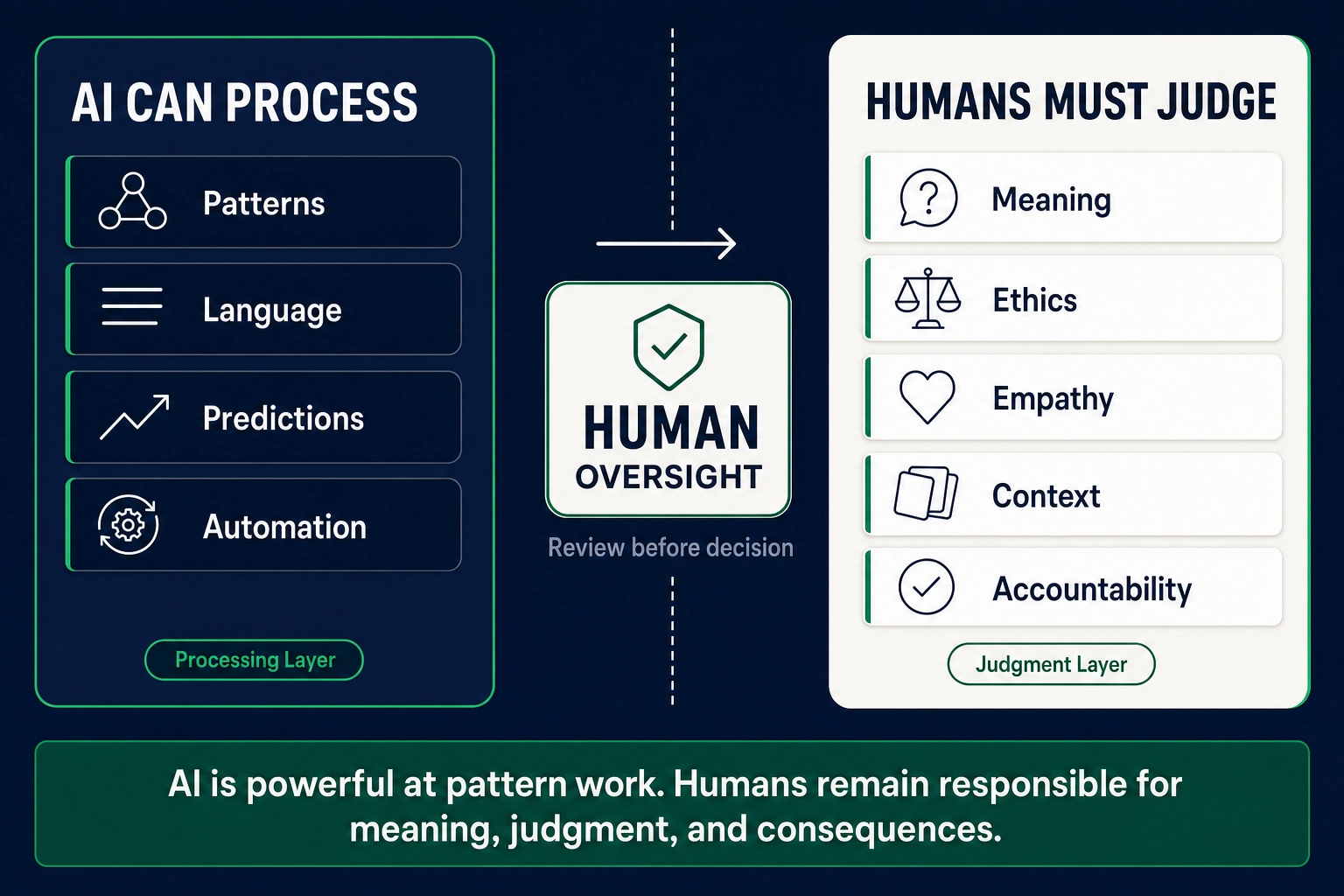
AI limitations matter because AI is increasingly used in consequential settings — hiring, healthcare, education, finance, customer service, legal services, and government.
When AI handles low-stakes tasks, mistakes are easy to correct. If an AI tool suggests a weak email subject line, you rewrite it. If it generates a generic study plan, you adjust it. If it summarizes an article poorly, you reread the source.
But when AI is used in high-stakes situations, its limitations become serious.
An AI system involved in hiring can reinforce bias without anyone realizing it. A medical AI tool can miss context a clinician would notice. A financial model can misread risk. A chatbot can provide misleading information to someone who trusts it. A recommendation system can shape what people see, believe, and buy.
The issue is not that AI is useless. The issue is that AI is often useful enough to be trusted too quickly. That gap — between what AI appears to be able to do and what it actually can do — is where problems tend to happen.
This is why AI literacy matters. People need to understand what these systems can do, what they cannot do, and what kind of oversight is necessary. These differences between AI and human intelligence have real consequences for how AI gets deployed and whether it gets used responsibly.
AI should support human thinking. It should not quietly replace human responsibility.
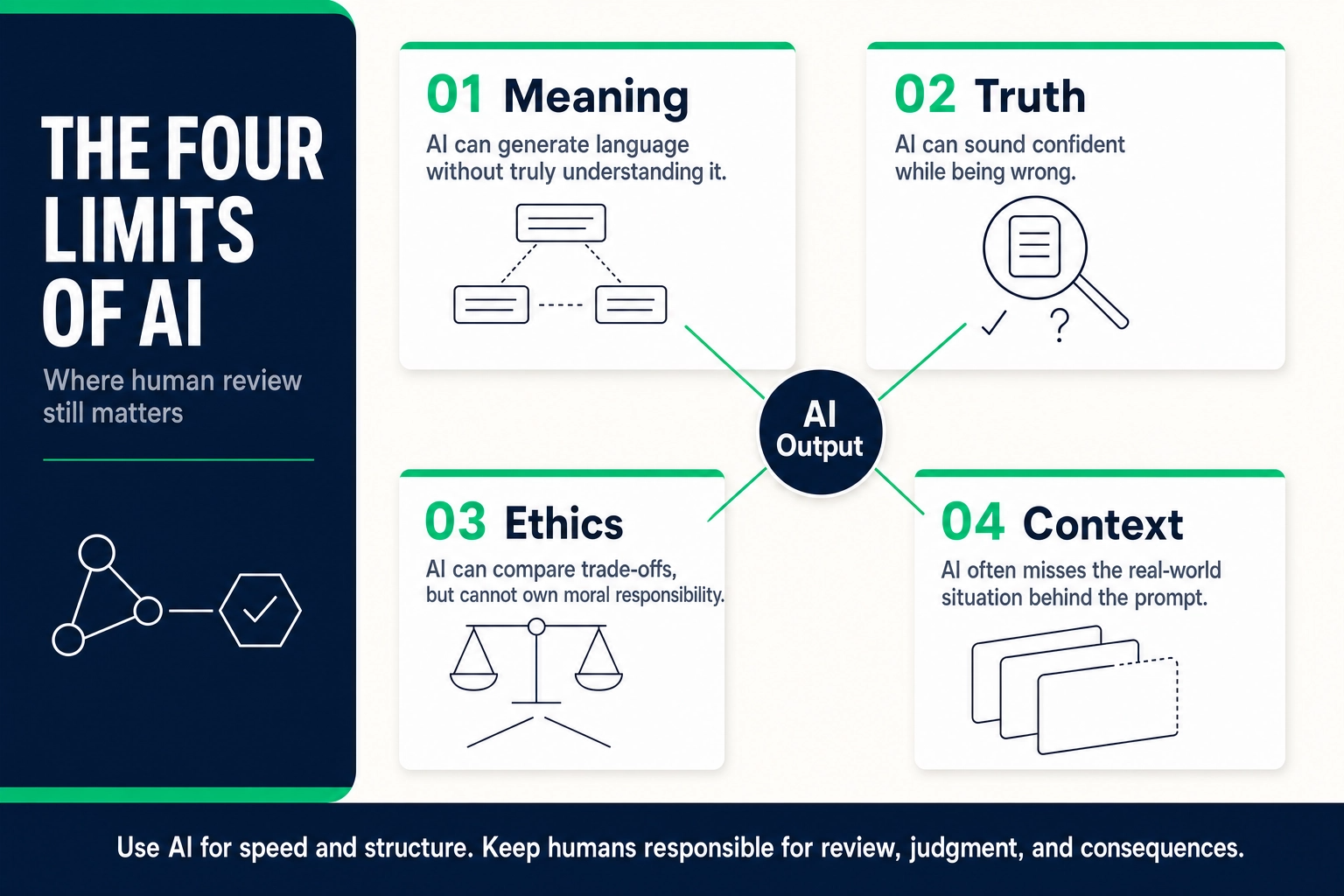
The table below summarizes the four most important categories of limitation and what to do about each.
| Limitation | What It Means | What To Do |
|---|---|---|
| Meaning | AI produces fluent language without truly understanding the world or the content it generates. | Review nuance, context, and important interpretations yourself, especially before sharing or acting on them. |
| Truth | AI can sound confident while producing false, outdated, or unsupported claims. | Verify facts, dates, citations, calculations, and high-stakes claims against reliable sources. |
| Ethics | AI can analyze trade-offs but has no values, conscience, or personal accountability. | Keep humans responsible for decisions that affect people's lives, rights, or wellbeing. |
| Context | AI often misses real-world constraints, interpersonal dynamics, and the full human situation behind a task. | Give clear, specific context and judge whether the output actually fits your situation. |
AI Does Not Truly Understand Meaning
One of the most persistent misconceptions about AI is that it understands what it says.
It does not understand meaning the way humans do.
Large language models can generate fluent, helpful, and detailed responses because they have learned patterns in language. They can identify relationships between words, phrases, topics, formats, and instructions. They can predict what kind of response is likely to fit a prompt. That is different from understanding.
A person understands language through experience, memory, emotion, context, culture, and physical life in the world. Humans know that words are connected to real people, places, objects, consequences, and feelings.
AI does not have that same connection.
It can explain grief without grieving. It can write about leadership without leading anyone. It can describe a place without visiting it. It can discuss fairness without having values. It can produce a sentence that sounds meaningful without experiencing meaning itself.
This distinction matters because AI can sound more capable than it is. A polished, well-structured answer creates the impression of understanding. But fluent language is not the same as comprehension. AI can generate the form of a good answer without fully grasping the reality behind it.
That is why AI outputs still need human review — especially when accuracy, nuance, or context matters.
A language model can explain grief without grieving, write about leadership without leading anyone, and discuss fairness without holding any values. Fluent output is not the same as genuine comprehension.
AI Still Struggles With Common Sense
AI has improved dramatically, but common sense remains one of its hardest problems.
Common sense is the everyday understanding people use to navigate the world. It includes basic expectations about objects, people, time, cause and effect, social behavior, physical limits, and practical consequences.
Humans build common sense through lived experience. We learn that glass can break, food can spoil, people may be upset even if they say they are fine, and a plan that looks good on paper can fail because of timing, budget, politics, or human behavior.
AI does not experience the world directly in that way. It learns patterns from data, not from living in the world. That means it can miss things that seem obvious to people — misread a social situation, give impractical advice, overlook physical constraints, or fail to recognize why something is inappropriate in context.
This is especially visible when AI is asked to solve messy real-world problems.
A prompt like "create a plan for launching a product" may produce a polished-looking plan. But the plan may not account for internal budget limits, team capacity, stakeholder politics, legal review timelines, market timing, or the simple reality that people do not behave like clean spreadsheet rows.
AI can help structure a problem. It can generate options and surface considerations. But it does not naturally know what will actually work in the real world unless the right context is provided and a human evaluates the result.
When a Polished Answer Misses the Point
The Prompt: "How should I handle a tense team meeting tomorrow where two senior people disagree on direction?"
The AI Response: A well-organized five-step plan — actively listen, acknowledge both perspectives, use data to find common ground, propose a structured compromise, and follow up in writing.
What AI Does Not Know: One of those people is being quietly managed out. The other has the CEO's ear. The team tried a structured compromise last quarter and it created more conflict. The meeting will be observed by HR. And the data both people cite are the same data — they just disagree on what it means.
The Result: The AI's plan sounds reasonable in the abstract and is completely wrong for this situation. AI processed the words of the prompt. It had no access to the actual situation behind them.
This is not a failure of AI intelligence. It is a structural limitation. Context that exists only in a room, a relationship, or a history cannot be given to a language model. Human judgment cannot be replaced by a well-formatted five-step plan.
AI Does Not Have Real-World Experience
AI does not have lived experience.
It has never managed a team, cared for a child, lost a job, sat in a tense meeting, negotiated a contract, dealt with grief, felt pressure, or made a decision with personal consequences. Much of human intelligence does not come only from information — it comes from consequences. People remember what happened when a decision went poorly. They adjust after difficult conversations. They develop instincts from repeated exposure to real situations. They learn what people mean when they do not say everything directly.
AI does not have instincts in that sense.
It can analyze patterns from examples of human experience, but it does not experience those things itself. It can describe what burnout feels like, but it has never been burned out. It can suggest how to manage a conflict, but it has never had to rebuild trust with someone after a difficult moment. It can generate parenting advice, but it has never had to calm a child at 2 a.m. with no sleep and no playbook.
This does not make AI unhelpful. It can be genuinely useful for drafting, planning, summarizing, brainstorming, and organizing thoughts. But its outputs should be filtered through human judgment — especially when the situation is personal, complex, emotionally loaded, or consequential.
The more personal, high-stakes, or contextually dense the situation is, the more important lived experience becomes. AI is useful support. It is not a substitute for judgment formed through actual experience.
Experience cannot be uploaded. AI can analyze thousands of documented examples of human experience, but it cannot have lived any of them. This matters most when the situation is personal, emotionally loaded, or consequential: exactly the moments where good judgment comes from having actually been through something similar, not from having read about it.
AI Cannot Feel Emotions or Empathy
AI can imitate emotional language. It cannot feel emotion.
When an AI chatbot says "I'm sorry you're going through that," it is generating a socially appropriate response based on language patterns. It is not feeling concern. It does not care in the human sense. It does not experience sadness, compassion, joy, guilt, or love.
This is one of the clearest and most important differences between AI and human intelligence.
Human emotions are connected to biology, memory, relationships, identity, and experience. Emotions influence how people make decisions, build trust, form relationships, create meaning, and respond to the world. When someone genuinely cares about how you are doing, that is different — behaviorally, morally, and practically — from an algorithm generating an empathetic-sounding sentence.
AI does not have an inner emotional life.
That matters in any situation where empathy is not just language — it is responsibility. A therapist, teacher, caregiver, manager, doctor, recruiter, or mediator is not simply producing the right words. They are interpreting emotion, reading context, building trust, and taking personal responsibility for how their response affects another person.
AI can support emotionally sensitive work. It can help draft a difficult message, organize thoughts, suggest communication approaches, or provide general information. But it should not be mistaken for a person who understands, cares, or will be held accountable for the outcome.
A convincing emotional response is not the same as empathy. That distinction matters, especially in the settings where people are most vulnerable.
When an AI system says "I understand how you feel" or "I'm sorry you're going through this," it is generating a statistically likely socially appropriate response, not expressing genuine concern or care. There is no inner emotional life behind the words. This distinction matters in any setting where trust depends on genuine human presence: therapy, hiring, caregiving, crisis response, and anywhere someone is at their most vulnerable.
AI Cannot Make Ethical Judgments on Its Own
AI does not have a moral compass.
It can analyze ethical frameworks, compare trade-offs, summarize policies, identify risks, and simulate different perspectives. But it does not have values, conscience, accountability, or responsibility. It cannot be wrong in a moral sense. It cannot feel the weight of a difficult decision.
Ethical judgment requires more than rule-following.
Humans often make ethical decisions by considering fairness, harm, rights, dignity, duty, relationships, context, and consequences. These decisions are rarely simple. The right answer may depend on competing values, power dynamics, unspoken norms, and the real people affected. Good ethical judgment is shaped by lived experience, care for others, and the understanding that decisions have consequences you are responsible for.
AI can support this process, but it cannot own it.
This is especially important when AI is used in high-stakes decisions. Hiring, lending, healthcare, education, policing, insurance, legal services, and government benefits all involve decisions that can affect people's lives, freedoms, and opportunities.
An AI system might rank candidates, flag risk, recommend action, or summarize evidence. But the responsibility for the decision belongs to the humans and institutions who deployed and relied on that system.
"The algorithm made the decision" is not an ethical answer. People designed the system, selected the training data, chose the model, approved the deployment, and defined the workflow. Human responsibility does not disappear because software was involved.
AI should support ethical thinking. It should not be used as a mechanism to outsource accountability.
AI Can Support
- Summarize ethical frameworks and policy positions
- Identify potential risks and unintended consequences
- Compare trade-offs across different options
- Simulate different stakeholder perspectives
- Organize considerations for human review
- Flag patterns that may indicate bias in data
Humans Must Own
- Define what the actual values are
- Weigh harm and fairness for real people
- Take responsibility for the outcome
- Recognize when rules are insufficient
- Be accountable when things go wrong
- Provide the ethical judgment that cannot be automated
AI Can Generate, But It Does Not Create Like Humans
AI can generate impressive content. It can write essays, produce images, compose music, draft scripts, create logos, design layouts, and generate ideas at significant scale and speed.
But AI creativity is different from human creativity.
AI generates by learning patterns from existing data and producing new combinations based on those patterns. It can imitate styles, remix ideas, produce variations, and accelerate creative workflows. What it generates may be technically proficient, stylistically coherent, and useful.
Human creativity is shaped by intention, emotion, memory, culture, taste, identity, constraints, and lived experience. People create because they want to express something, solve something, challenge something, or make something meaningful to them and to others.
AI does not have desire, purpose, or personal perspective.
That does not mean AI-generated work has no value. AI can be a powerful creative tool — useful for brainstorming directions, drafting rough concepts, generating alternatives, breaking through creative blocks, and accelerating production. Many people use AI effectively as part of a creative process.
But the human role remains central.
Humans decide what is original, relevant, tasteful, meaningful, accurate, ethical, and worth publishing. Humans bring point of view. Humans understand audience, timing, cultural context, and emotional resonance in ways that go beyond pattern matching.
AI can generate options. Humans decide what deserves to exist.
AI generation vs. human creativity
AI can produce. Humans create with intention, judgment, context, and taste. That difference matters.
Learns statistical patterns from existing content. Produces new combinations of those patterns at scale and speed. Can imitate styles, remix structures, and accelerate production. Has no intention, desire, or personal stake in what it creates.
Shaped by lived experience, personal intent, cultural context, and emotional investment. Creates to express, challenge, or communicate something meaningful. Exercises taste, restraint, and judgment about what deserves to exist.
AI Can Be Confident and Still Be Wrong
One of AI's most consequential practical limitations is that it can produce wrong answers with complete confidence.
This is what researchers and practitioners call an AI hallucination — when a model generates information that sounds plausible but is false, unsupported, misleading, or simply made up. A hallucination might look like an invented statistic, a misquoted law, a fake citation, a name attached to the wrong person, or a detailed answer to a question the model does not actually have enough information to answer correctly.
This happens because AI is designed to generate likely-sounding outputs, not to guarantee truth.
A language model produces sentences that fit the pattern of a good answer — even if the underlying facts are wrong. The response may be polished, detailed, and written with authority. That combination can make errors harder to spot, not easier.
This is one of the biggest practical risks for everyday AI users. People are more likely to trust information when it is presented clearly and confidently. AI can produce that style regardless of whether the substance is accurate.
The solution is not to avoid AI altogether. The solution is to verify.
For anything consequential — legal claims, medical information, financial data, academic citations, technical specifications, historical facts — users should check sources, ask AI to provide its basis, cross-reference against reliable references, and apply human expertise before acting. Verification is not optional. It is part of using AI responsibly.
AI hallucinations are not rare edge cases. They are a known, ongoing limitation of how large language models work. AI generates likely-sounding responses, not verified truth. The more confident and detailed an answer appears, the harder an error may be to detect. For anything consequential, including legal, medical, financial, academic, or technical information, verify before you rely on it.

AI Depends on Data and Context
AI is only as useful as the data, context, and instructions it has access to.
If the training data is biased, incomplete, outdated, or low quality, the model will produce flawed outputs. If a prompt is vague, the response may be generic and miss the actual need. If important context is missing, AI will fill in the gaps — and it typically will not flag that it is guessing.
This is why AI can perform well on one task and poorly on one that looks nearly identical from the outside.
Consider a simple example: an AI tool may generate a reasonable-sounding job description. But without knowing the company, the role level, the reporting structure, the team culture, the compensation range, the location, and what the hiring manager actually needs in this hire — it will produce something that looks polished but is completely wrong for the real situation.
The same dynamic applies in strategy, marketing, education, healthcare, finance, and personal advice. AI has access to the words and context you provide. It does not have access to everything you know, everything that is at stake, or what is actually happening in your organization or life.
This is why prompting matters. A well-crafted prompt does not make AI truly understand your situation, but it gives the model much better direction, reduces unnecessary guessing, and narrows the gap between what you need and what comes out. Context is not optional. It is part of the work of using AI well.
Better Context Before You Prompt
Before you send a prompt on anything important, check whether you have given AI what it needs to actually help you.
- Have I described the goal clearly, not just the task, but the outcome I want?
- Have I provided the background context that shapes the answer?
- Have I mentioned key constraints, limits, or things to avoid?
- Have I specified the format, length, or structure I need?
- Have I told AI who the audience is?
- Have I noted anything sensitive or important that AI might not assume?
- Am I asking AI to guess at information it cannot reasonably have?
AI Struggles Outside Its Training and Instructions
AI systems are strongest when tasks are clearly defined and similar to patterns they have been trained on. They are weaker — sometimes significantly — when situations are unfamiliar, ambiguous, highly contextual, or outside the data and instructions they were built on.
This is sometimes called brittleness. A system that performs well in controlled, familiar conditions can fail when the real world changes in unexpected ways. A model trained on one type of data may struggle with another. A tool designed for one workflow may behave unpredictably when applied to something adjacent.
Practical examples: a customer service AI may answer common product questions accurately but struggle with unusual cases that fall outside its training. A computer vision model may identify objects reliably in good lighting but fail with poor image quality or unusual angles. A financial forecasting model may perform well during stable market conditions but produce unreliable outputs during genuine disruptions.
This matters because real life is not always predictable, consistent, or clean. Humans are often better at adapting to unfamiliar situations because we can combine experience, judgment, intuition, and values — even when we have never encountered that exact situation before.
AI does not automatically know when the situation has shifted enough to make its usual patterns unreliable. It does not flag uncertainty the way a competent person would. This is why human oversight is especially important in edge cases, exceptions, and novel situations — precisely the moments when AI is most likely to be wrong and most likely to sound confident about it.
The Reliability Traps People Fall Into
Most AI mistakes do not happen because people are reckless. They happen because the output looks polished enough to lower your guard. That is the sneaky part. AI can sound organized, confident, and specific while still being incomplete, misleading, or flat-out wrong.
Here are the most common reliability assumptions to avoid when using AI for research, writing, work decisions, or anything that requires accuracy.
"AI was confident, so the answer must be right."
Confidence is a style, not an accuracy signal. AI generates responses that fit the pattern of a good answer, not responses that have been verified as true. Better approach: treat AI outputs as a starting point that requires review, not a conclusion that has already been checked.
"I gave AI good context, so it fully understands my situation."
Better context improves AI outputs significantly, but it does not give AI the lived experience, organizational knowledge, or real-world grounding that full understanding requires. Better approach: context helps, but human judgment still needs to evaluate whether the output actually fits.
"AI handled similar tasks before, so it will handle this one too."
AI can be brittle. A small change in the task, input, or situation can lead to meaningfully weaker outputs. What worked well in one context does not automatically generalize. Better approach: evaluate each output on its own merits rather than assuming consistent performance.
"If I re-prompt it enough times, AI will figure out what was wrong."
Re-prompting can improve outputs, but it can also produce a range of plausible-sounding wrong answers. If AI is getting something wrong systematically, the issue may be a limitation of the model or missing context. Better approach: identify what information is missing or involve a human who knows the answer.
AI Cannot Take Responsibility
AI cannot be accountable — and this is one of the most important limitations in business, law, and society.
It cannot explain itself in a moral sense. It cannot apologize with understanding. It cannot repair harm. It cannot accept consequences. It cannot be held responsible for a bad decision the way a person or institution can.
If an AI system gives harmful advice, rejects a qualified job candidate, misclassifies a medical scan, flags an innocent transaction as fraudulent, or produces biased output that affects someone's opportunity — the responsibility does not belong to the AI. It belongs to the people and organizations that designed it, selected it, deployed it, monitored it, and relied on its outputs.
"The algorithm made the decision" is not an ethical answer. It is not even a complete description of what happened. People chose to use the tool, chose the training data, chose the model, approved the workflow, and decided how the output would be used. Human decisions are embedded throughout that chain — and human accountability belongs throughout it too.
As AI is used in more consequential situations, the temptation to use it as a shield against accountability grows. Organizations need to resist that. They need policies, review processes, escalation paths, audits, documentation, and clear named ownership of decisions that AI informs.
AI can support decisions. It cannot shoulder the responsibility for them.
BuildAIQ Framework
The Human Accountability Test
When AI is involved in a consequential decision, ask these five questions before acting on the output.
Who chose and deployed this AI system?
Someone made the decision to use this tool for this task. That person or organization is responsible for the outcome, not the model.
Who selected or approved the training data?
The data shapes the model's behavior. Whoever approved it owns the biases, gaps, and limitations it contains.
Who reviewed the output before it was acted on?
If the answer is "no one," that is a gap in the process, not a feature of AI.
Who is responsible if this output causes harm?
If the answer is "the AI," that is not acceptable. AI cannot be held accountable. A person or organization can and must be.
Can a person affected by this decision appeal it?
If there is no human review path, no escalation, and no named accountability, that is the accountability gap AI creates when deployed without oversight.
What These Limitations Mean for You
Understanding AI's limitations helps you avoid two traps: blindly trusting it because it sounds intelligent, or dismissing it because it is imperfect.
The better approach is practical and clear-eyed.
Use AI for tasks where it reliably performs well: summarizing information, drafting first versions, brainstorming ideas, organizing notes, analyzing patterns, creating outlines, generating options, explaining concepts, automating repetitive structured work, and supporting research.
Use more caution — and keep human judgment actively involved — when tasks require: current and verified facts, legal judgment, medical or health advice, financial decisions, emotional support, ethical trade-offs, safety decisions, hiring or lending decisions, complex interpersonal context, or sensitive personal information.
AI is most useful when you treat it as a capable assistant, not an unquestionable authority. That means reviewing outputs before you act on them, providing clear and specific context upfront, verifying important claims before you rely on them, protecting private information, and keeping judgment active in situations where the stakes are real.
The Beginner's Guide to Using AI Safely covers practical steps for applying all of this to everyday use.
Before You Act on an AI Output
Run through this checklist whenever AI is involved in something consequential, before sharing, publishing, or making a decision based on what it generated.
- Did I give AI enough context to understand my actual situation?
- Is this a high-stakes area, such as legal, medical, financial, safety, hiring, or ethics?
- Have I verified key facts, statistics, or citations against a reliable source?
- Did I review the output for accuracy and tone before sending or publishing it?
- Is there a human expert who should review this before it is acted on?
- Does this output fall in an area where AI is known to hallucinate or struggle?
- Am I about to make a decision affecting other people based on this output alone?
Final Takeaway
AI can do a lot, but it still cannot do everything.
It cannot truly understand meaning. It does not have common sense in the human sense. It lacks lived experience, emotions, empathy, a moral compass, consciousness, or accountability. It can generate impressive content without creating from personal intention. It can produce confident answers that are still wrong.
These limitations do not make AI useless. They make AI something that needs to be used intelligently.
AI is best understood as a powerful support system — fast, scalable, useful, and increasingly capable, but still dependent on quality data, sufficient context, clear instructions, and meaningful human oversight.
The most effective AI users are not the ones who trust it blindly. They are the people who know how to guide it, question it, verify it, and decide when human judgment matters more than what the model produced. Understanding what AI still cannot do is not a reason to fall behind. It is how you use AI better.
FAQs
Frequently Asked Questions
What can AI not do?
AI cannot truly understand meaning, apply common sense reliably, draw on lived experience, feel emotions or empathy, make ethical judgments on its own, guarantee factual accuracy, or take responsibility for its outputs. It can also hallucinate — generating false information with full confidence, without flagging uncertainty.
Does AI understand what it says?
No. AI generates language that sounds meaningful, but it does not understand meaning the way humans do. It identifies patterns in data and produces responses that fit those patterns. Fluent, detailed, well-organized output is not the same as genuine comprehension.
Can AI feel emotions?
No. AI can imitate emotional language, but it does not feel emotions. It has no consciousness, lived experience, or inner emotional life. Responses that sound empathetic are generated based on language patterns, not felt.
Can AI make ethical decisions?
AI can analyze ethical questions and compare trade-offs, but it does not have values, conscience, or moral responsibility. Humans must remain accountable for decisions that affect people, especially in hiring, healthcare, finance, education, law, and safety. "The algorithm decided" is not an ethical answer.
Why does AI get things wrong?
AI generates likely-sounding responses based on patterns in training data, not verified facts. Missing context, biased or outdated training data, ambiguous prompts, and topics outside its training can all produce errors. AI does not have a reliable internal mechanism for detecting when it is wrong, which is why hallucinations can sound just as confident as accurate answers.
Should humans still review AI outputs?
Yes, especially for anything consequential. Human review is important for legal, medical, financial, hiring, safety, and ethical decisions. AI can support decision-making. It should not replace human judgment in situations where errors have real consequences for real people.